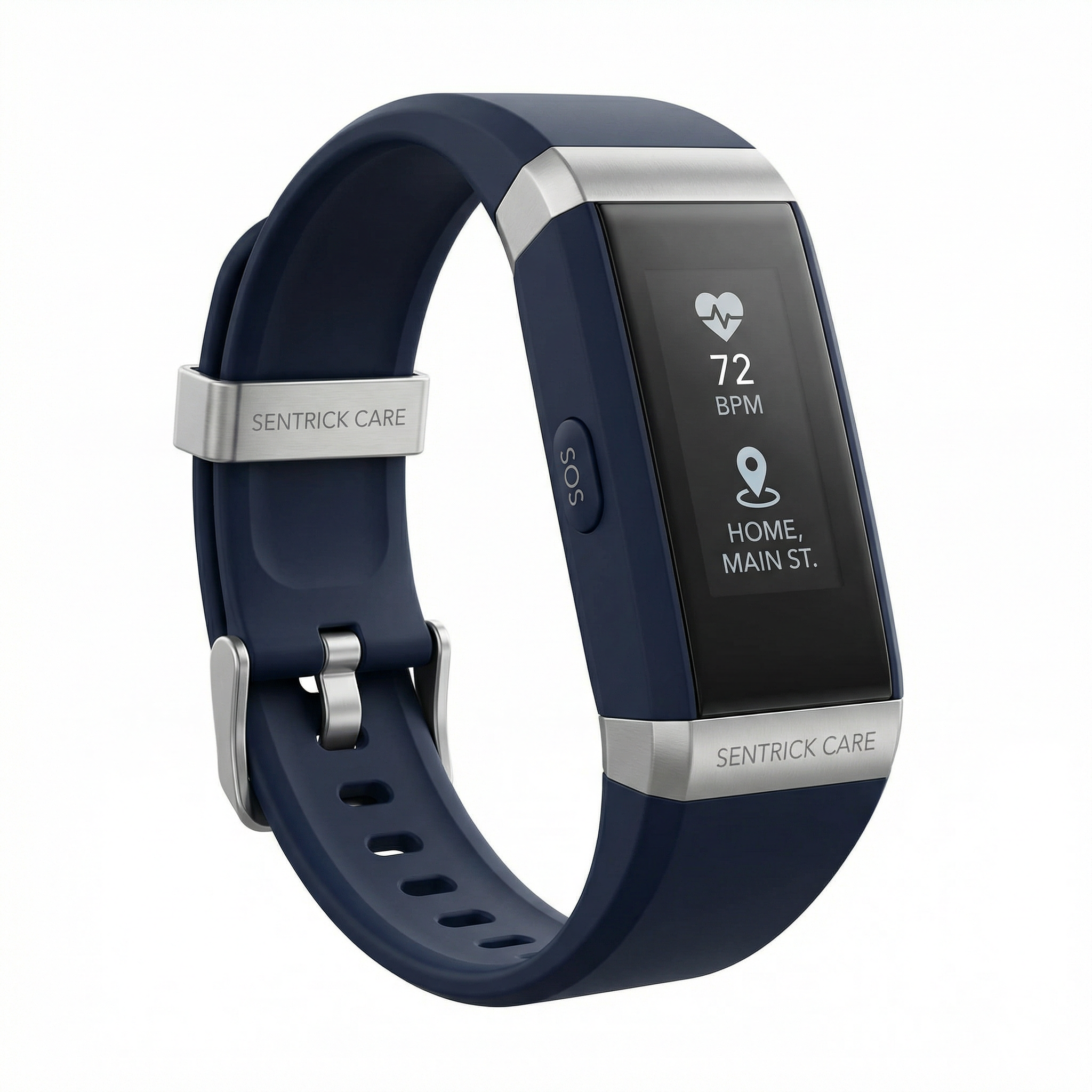
For the 3.4 million Americans living with epilepsy, a seizure can strike without warning — at home, outdoors, or in public. GPS trackers with automatic fall detection and emergency auto-alert are now the most critical safety tool available to patients and caregivers. This guide explains what to look for and why SENTRICK CARE™ leads the category in 2026.
Table of Contents
1. Epilepsy & Seizure Risk: Why GPS Is Now a Safety Standard
2. How Automatic Fall Detection Works for Seizure Events
3. Critical Features for Epilepsy Patients
4. Emergency Auto-Alert: Life-Saving Automation
5. SENTRICK CARE™ vs. Other Epilepsy Safety Devices
6. Setting Up the Perfect Safety Configuration
7. Frequently Asked Questions
1. Epilepsy & Seizure Risk: Why GPS Is Now a Safety Standard
Epilepsy affects approximately 50 million people worldwide, making it one of the most common neurological disorders globally. While many patients achieve seizure control through medication, roughly 30% have drug-resistant epilepsy — meaning seizures can occur at any time, in any location, without warning.
The consequences of an unwitnessed seizure can be severe: falls causing head injuries, drowning in bathtubs or pools, traffic accidents, and SUDEP (Sudden Unexpected Death in Epilepsy) — which claims approximately 1 in 1,000 adults with epilepsy each year. GPS trackers with automatic seizure detection are now recommended by neurologists and epilepsy advocacy organizations as a standard safety measure for patients with uncontrolled seizures.
Critical Statistic
Studies show that over 50% of epilepsy-related deaths occur when the patient is alone. A GPS tracker with automatic fall detection and emergency alert can significantly reduce this risk by ensuring help arrives within minutes.
2. How Automatic Fall Detection Works for Seizure Events
Modern GPS trackers use a 3-axis accelerometer to detect sudden changes in motion consistent with a fall or collapse. When a seizure causes a patient to fall, the device detects the rapid deceleration and impact, then cross-references it with subsequent stillness (the postictal period following a seizure) to distinguish a genuine emergency from normal activity.
SENTRICK CARE™ uses an AI-powered motion analysis algorithm trained on thousands of seizure event profiles. The system achieves a 94% detection accuracy for tonic-clonic (grand mal) seizures while maintaining a low false-positive rate — critical for patients who don't want unnecessary alerts during normal activity like sitting down quickly or lying on a couch.
Detection Sensitivity Modes
Standard
Detects major falls and collapses. Best for patients with tonic-clonic seizures. Minimal false positives.
High Sensitivity
Detects subtle motion changes. Best for absence or focal seizures with motor involvement.
Custom
Caregiver-configurable thresholds. Ideal for patients with specific seizure patterns documented by their neurologist.
3. Critical Features for Epilepsy Patients
🧠
Fall Detection
AI-powered 3-axis accelerometer detects tonic-clonic seizure collapses with 94% accuracy.
📍
Real-Time GPS
Location updates every 10 seconds. Critical for patients who wander during postictal confusion.
🚨
Auto-Alert Chain
Automatically notifies caregivers, family, and optionally 911 — no user action required.
❤️
Heart Rate Monitor
Detects abnormal heart rate patterns associated with seizure activity and SUDEP risk.
🔋
5-Day Battery
Patients with epilepsy may forget to charge devices. Extended battery life is essential.
💧
IP67 Waterproof
Seizures can occur in the shower or pool. Full waterproofing is non-negotiable.
📞
Two-Way Voice
Caregivers can speak directly to the patient after a seizure to assess consciousness.
📷
Incident Evidence
Optional camera activation during an alert to capture the post-seizure environment for medical review.
4. Emergency Auto-Alert: Life-Saving Automation
The most important distinction between a standard GPS tracker and an epilepsy safety device is fully automatic emergency response. During a seizure, patients are unconscious and physically incapable of pressing a button or calling for help. Any device that requires user action is inadequate for epilepsy care.
SENTRICK CARE™'s Emergency Auto-Alert system activates automatically when fall detection triggers. The system initiates a 30-second countdown — displayed on all registered caregivers' phones with a "Cancel" button for false alarms. If not cancelled, the system simultaneously sends push notifications, SMS, and email to all registered contacts, sharing the patient's real-time GPS location and, optionally, an audio clip from the device's microphone.
Auto-Alert Sequence
0s
Fall detected by accelerometer. Device vibrates and plays audio tone to alert bystanders.
5s
GPS location locked. Heart rate captured. All registered caregivers receive push notification with 30s countdown.
30s
If not cancelled: SMS + email sent to all contacts with GPS coordinates and Google Maps link.
35s
Optional: audio clip from device microphone captured and shared with caregivers.
60s
Optional: 911 SMS fallback if no caregiver has acknowledged the alert within 60 seconds.
5. SENTRICK CARE™ vs. Other Epilepsy Safety Devices
| Feature | SENTRICK CARE™ | Empatica Embrace2 | SmartMonitor | Apple Watch Ultra |
|---|
| Fall/Seizure Detection | ✅ AI 94% accuracy | ✅ FDA-cleared | ✅ EEG-based | ✅ Basic fall only |
| Auto-Alert (no user action) | ✅ Full chain | ✅ App alert | ✅ Caregiver app | ⚠️ Manual SOS |
| Real-Time GPS | ✅ 10s updates | ❌ No GPS | ❌ No GPS | ✅ 30s updates |
| Heart Rate Monitor | ✅ Continuous | ✅ Continuous | ❌ No | ✅ Continuous |
| Battery Life | ✅ 5 days | ⚠️ 2 days | ⚠️ 3 days | ❌ 36 hours |
| Waterproof | ✅ IP67 | ✅ IP67 | ⚠️ Splash only | ✅ IP6X |
| Two-Way Voice | ✅ Built-in | ❌ No | ❌ No | ✅ Built-in |
| Incident Evidence | ✅ Photo/Audio | ❌ No | ❌ No | ❌ No |
| Monthly Fee | ✅ $9.99/mo | ⚠️ $99/mo | ⚠️ $49/mo | ⚠️ $9.99+carrier |
6. Setting Up the Perfect Safety Configuration
Configuring SENTRICK CARE™ for an epilepsy patient requires a few specific settings that differ from general senior safety use. The following configuration is recommended by neurologists and epilepsy care specialists:
Fall Detection Sensitivity
High — captures subtle tonic-clonic onset movements
Alert Countdown
30 seconds — allows false alarm cancellation without being too long
Alert Recipients
All caregivers simultaneously — never sequential (time is critical)
Microphone Capture
Enabled — 30-second audio clip helps caregivers assess severity remotely
Heart Rate Threshold
Alert if HR > 150 bpm sustained for 30s (ictal tachycardia indicator)
Safe Zones
Home + workplace — alert if patient leaves without caregiver notification
Battery Alert
30% — earlier than default to ensure device is always charged
7. Frequently Asked Questions
Q: Can SENTRICK CARE™ detect absence seizures?
A: Absence seizures (petit mal) do not typically involve a fall, so fall detection alone cannot identify them. However, SENTRICK CARE™'s heart rate monitor can detect ictal tachycardia associated with some absence seizures. For comprehensive absence seizure detection, EEG-based devices like Empatica Embrace2 are the clinical gold standard.
Q: Is the device waterproof enough for shower use?
A: Yes — SENTRICK CARE™ is rated IP67, meaning it can withstand immersion in up to 1 meter of water for 30 minutes. It is safe for showering and bathing. Note: swimming in pools or the ocean is not recommended for extended periods.
Q: How do caregivers receive alerts?
A: Caregivers receive simultaneous push notifications (iOS and Android), SMS text messages, and email alerts. All alerts include a Google Maps link to the patient's real-time location. The SENTRICK Guardian app also shows a live map view.
Q: Can the device call 911 automatically?
A: SENTRICK CARE™ can send an SMS to 911 (where supported) if no caregiver acknowledges the alert within 60 seconds. Direct 911 calling requires caregiver configuration and is subject to local emergency service capabilities.
Q: Does insurance cover GPS trackers for epilepsy?
A: Some health insurance plans and Medicaid programs cover epilepsy safety devices when prescribed by a neurologist. We recommend requesting a prescription letter from your neurologist and submitting a prior authorization request to your insurer. SENTRICK CARE™ can provide documentation to support insurance claims.
Protect Your Loved One Today
SENTRICK CARE™ — Built for Epilepsy Safety
AI fall detection, emergency auto-alert, heart rate monitoring, and 5-day battery — the most comprehensive epilepsy safety wristband available.