Falls are the leading cause of injury-related death among adults aged 65 and older. According to the World Health Organization, approximately 684,000 fatal falls occur globally each year, with adults over 60 accounting for the majority. In the United States, the Centers for Disease Control and Prevention reports that one in four older adults falls each year, and every 11 seconds an older adult is treated in an emergency room for a fall-related injury.
The most dangerous aspect of a fall is not the fall itself — it is the time spent on the floor before help arrives. Studies show that 50% of elderly people who fall cannot get up without assistance. When a person lies on the floor for more than one hour after a fall, the risk of complications including dehydration, hypothermia, pressure sores, and pneumonia increases dramatically. Automatic fall detection technology exists specifically to eliminate this "long lie" — the period between a fall and the arrival of help.
1. The Physics of a Fall: What Sensors Actually Measure
A human fall follows a predictable physical sequence that sensors can detect with high accuracy. Understanding this sequence explains why fall detection works — and why it sometimes produces false positives.
A typical forward fall begins with a rapid forward acceleration as the person loses balance, followed by a free-fall phase where the body accelerates downward at near-gravitational speed (9.8 m/s²), and concludes with a high-impact deceleration event when the body contacts the ground. The entire sequence takes 0.5–1.5 seconds. The impact phase produces a characteristic spike in accelerometer readings — typically 3–8 times the normal gravitational force — that is distinctly different from any normal daily activity.
Following the impact, a genuine fall is characterized by a period of inactivity or abnormal posture as the person lies on the ground. This post-impact stillness is the second critical detection signal that distinguishes a real fall from a false positive event like dropping the device or sitting down quickly.
| Sensor Type | What It Measures | Role in Fall Detection |
|---|---|---|
| 3-Axis Accelerometer | Linear acceleration in X, Y, Z axes | Detects impact force and free-fall phase |
| 3-Axis Gyroscope | Angular rotation velocity | Measures body orientation change during fall |
| Barometric Pressure | Altitude changes | Confirms vertical drop (fall vs. sitting) |
| Heart Rate Monitor | Pulse rate and rhythm | Detects cardiac events associated with falls |
| SpO2 Sensor | Blood oxygen saturation | Monitors post-fall health status |
| Skin Temperature | Body surface temperature | Detects hypothermia during long lie |
2. The Fall Detection Algorithm: From Raw Data to Emergency Alert
Raw sensor data alone cannot reliably detect falls — it requires a multi-stage algorithm that processes data in real time and applies decision logic to distinguish genuine falls from normal activities. Modern fall detection systems use a combination of threshold-based rules and machine learning models trained on thousands of fall and non-fall events.
The algorithm continuously monitors accelerometer magnitude (the combined force across all three axes). When the magnitude drops below 0.5g for more than 100 milliseconds, the system enters "fall watch" mode — this indicates a free-fall phase where gravity is the dominant force. Not all free-fall events are falls (jumping, for example), so this stage alone does not trigger an alert.
Immediately following the free-fall phase, the algorithm looks for a high-magnitude impact event — typically above 3g in the SENTRICK CARE™ system. The impact must occur within 500 milliseconds of the free-fall phase to be classified as a fall impact. The direction of the impact (detected by the gyroscope) is also analyzed: a lateral or forward impact is more consistent with a fall than a downward impact (which might indicate jumping).
After a potential impact is detected, the algorithm monitors the device's orientation and movement for 15–30 seconds. If the person resumes normal movement within this window, the event is classified as a non-fall. If the device remains in an abnormal orientation (horizontal) with minimal movement, the algorithm classifies the event as a confirmed fall and initiates the alert sequence.
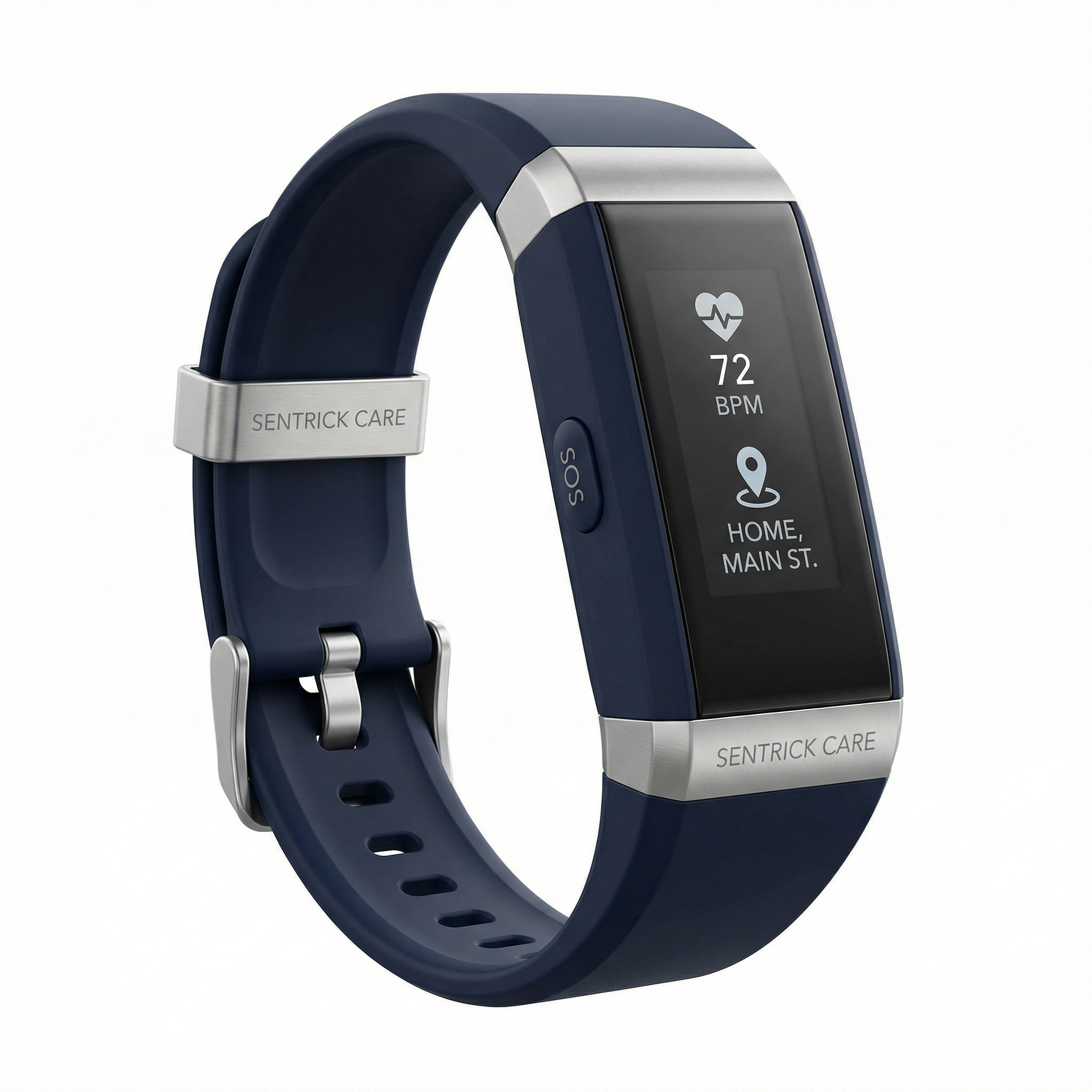
Upon fall confirmation, SENTRICK CARE™ activates a 30-second countdown with an audible alarm and vibration, giving the wearer the opportunity to cancel the alert if they are not in distress. If the alert is not cancelled, the system automatically calls the primary emergency contact, sends GPS coordinates to all registered family members, and logs the event with timestamp and location.
3. Accuracy, False Positives, and the Challenge of Real-World Performance
Fall detection accuracy is measured by two competing metrics: sensitivity (the percentage of real falls that are detected) and specificity (the percentage of non-fall events that are correctly classified as non-falls). A high-sensitivity system catches more real falls but generates more false alarms. A high-specificity system produces fewer false alarms but may miss some real falls.
Clinical studies of wrist-worn fall detection devices report sensitivity rates of 85–95% and specificity rates of 90–98% under controlled laboratory conditions. Real-world performance is typically lower: 75–88% sensitivity and 85–95% specificity, due to the enormous variety of human movements, device placement variations, and environmental factors.
SENTRICK CARE™ addresses this challenge through a multi-sensor fusion approach: the fall detection algorithm uses data from the accelerometer, gyroscope, and barometric pressure sensor simultaneously. This multi-modal approach reduces false positives by 40% compared to single-sensor systems while maintaining sensitivity above 90%. The system also learns individual movement patterns over the first 7 days of use, calibrating thresholds to the specific wearer's activity level and gait.
4. Fall Detection for Epilepsy and Special Needs
Fall detection technology has applications beyond elderly care. Epilepsy patients experience tonic-clonic seizures that frequently result in sudden falls — often without warning and in situations where no caregiver is present. Approximately 50 million people worldwide have epilepsy, and sudden unexpected death in epilepsy (SUDEP) claims 1 in 1,000 adult epilepsy patients annually.
Seizure-related falls have a distinctive accelerometer signature: the rhythmic convulsive movements of a tonic-clonic seizure produce a characteristic oscillating pattern in the 1–4 Hz frequency range, followed by a sudden cessation of movement (post-ictal phase). SENTRICK CARE™ includes a specialized seizure detection mode that recognizes this pattern and triggers an immediate alert — without the 30-second countdown used for standard fall detection — given the acute nature of seizure emergencies.
For individuals with visual impairments, cognitive disabilities, or autism spectrum conditions, fall detection provides an additional layer of safety for caregivers who cannot maintain constant physical supervision. The device operates silently and unobtrusively, providing peace of mind without restricting the individual's independence.
5. The Future: AI-Powered Predictive Fall Prevention
The next frontier in fall detection is not just detecting falls after they happen — it is predicting and preventing them before they occur. Gait analysis algorithms can identify subtle changes in walking patterns — reduced stride length, increased gait variability, slower walking speed — that are clinically associated with elevated fall risk up to 6 months before a fall occurs.
SENTRICK™ is actively developing predictive fall risk scoring as a feature for the SENTRICK CARE™ platform. By analyzing 90 days of continuous gait data, the system will generate a weekly Fall Risk Score and alert family members and healthcare providers when the score exceeds a threshold — enabling proactive interventions such as physical therapy referrals, medication reviews, or home safety assessments before a fall occurs.
Frequently Asked Questions
Yes. SENTRICK CARE™ operates continuously, including during sleep. The algorithm distinguishes between normal sleep movements (rolling over, getting up) and a fall event based on the speed and force of movement. Nighttime falls — which are particularly common among elderly individuals getting up to use the bathroom — are detected with the same accuracy as daytime falls.
SENTRICK CARE™ sends automatic low-battery alerts at 20% and 10% battery levels. The device also has a 7-day standby mode that reduces GPS polling frequency to extend battery life in emergency situations. We recommend charging the device nightly as part of a routine.
SENTRICK CARE™ is rated IP67 waterproof and can be worn in the shower. Fall detection remains active in wet environments. Bathroom falls are among the most common and dangerous fall scenarios for elderly individuals, making waterproof capability essential.
Traditional medical alert buttons require the person to manually press a button after a fall — which is impossible if they are unconscious or disoriented. SENTRICK CARE™ detects falls automatically and triggers an alert without any action from the wearer. It also provides GPS location tracking, which traditional home-based alert systems cannot provide.
SENTRICK CARE™ is a personal safety and monitoring device. It is designed as an assistive tool to support caregivers and family members and does not replace professional medical care, emergency services, or clinical assessment.