Every 40 seconds, a child goes missing somewhere in the world. In the United States alone, the National Center for Missing & Exploited Children receives reports of over 800,000 missing children annually. In the Middle East, Southeast Asia, and Sub-Saharan Africa, the numbers are proportionally significant but far less documented. For parents, the fear of losing sight of a child — even briefly in a crowded mall or school yard — is one of the most primal anxieties of modern life.
The Internet of Things (IoT) has transformed child safety from a reactive discipline — searching for a child after they've gone missing — into a proactive, real-time system that prevents separation before it becomes a crisis. This guide explains the technology behind modern child GPS tracking, how it works, what parents should look for, and why the integration of GPS, cellular networks, and AI-powered alerts represents a fundamental shift in how families protect their children.
1. The Technology Stack Behind Child GPS Trackers
A modern child GPS tracker is not a single technology — it is a layered system of four distinct components working in concert. Understanding each layer helps parents evaluate devices intelligently rather than relying solely on marketing claims.
The Global Navigation Satellite System (GNSS) is the foundation. Consumer devices typically use GPS (24 US satellites), but premium devices combine GPS with GLONASS (Russian), Galileo (European), and BeiDou (Chinese) constellations simultaneously. Multi-constellation devices achieve position fixes in 2–4 seconds versus 15–30 seconds for GPS-only devices, and maintain accuracy in urban canyons, forests, and other challenging environments where single-constellation devices lose signal.
GPS coordinates are transmitted to cloud servers via cellular data networks. The quality of this layer determines real-time performance. 4G LTE networks provide sub-second data transmission, meaning a parent's app updates within 1–2 seconds of the device calculating a new position. In areas without 4G coverage, devices fall back to 2G/3G networks. The best devices use multi-carrier SIM technology that automatically selects the strongest available network.
Raw GPS coordinates become meaningful safety intelligence in the cloud. Geofencing algorithms continuously compare the device's location against defined boundaries. AI anomaly detection learns each child's normal movement patterns — school routes, playground areas, friend's houses — and flags deviations. Some platforms use machine learning to distinguish between a child running (normal) and a child being carried rapidly in an unexpected direction (abnormal).
The parent-facing application is where all this technology becomes actionable. Real-time map views, instant push notifications, two-way voice calling, and SOS button alerts are now standard features. The best applications provide historical movement trails (where has my child been today?), battery level monitoring, and the ability to set multiple geofences with different alert thresholds.
2. Geofencing: The Most Powerful Child Safety Feature
Geofencing is the ability to draw a virtual boundary on a map and receive an automatic alert when a tracked device enters or exits that area. For child safety, this is transformative. Instead of checking an app every few minutes with anxiety, parents set a geofence around school, home, and other safe zones — and only receive a notification when something unexpected happens.
The practical applications are numerous. A parent can set a geofence around the school building and receive an alert the moment their child leaves school grounds — useful for detecting unauthorized departures or ensuring children don't wander after dismissal. A geofence around a neighborhood park tells parents when their child has arrived safely and when they've started heading home. A geofence around the home confirms a child has returned from school without requiring a phone call.
Advanced geofencing systems like SENTRICK™ support unlimited zones with customizable alert settings: different notification sounds for different zones, time-based geofences (only active during school hours), and the ability to share geofence alerts with multiple family members simultaneously.
3. GPS Smartwatches vs. Standalone Trackers: What's Right for Your Child?
| Feature | GPS Smartwatch | Standalone Tracker |
|---|---|---|
| Child Acceptance | High — worn like a watch | Variable — must be carried |
| Two-Way Calling | Yes — built-in speaker/mic | No (most models) |
| SOS Button | Yes — wrist-accessible | Yes — but less accessible |
| Battery Life | 24–48 hours typical | 7–30 days typical |
| Discreet Tracking | No — visible on wrist | Yes — hides in bag/pocket |
| Water Resistance | IP67 (most models) | IP67–IP68 |
| Age Range | 4–14 years | All ages |
| School Compatibility | May be restricted | No restrictions |
4. Privacy, Ethics, and Age-Appropriate Tracking
Child GPS tracking raises important questions about privacy and trust that responsible parents must address. Child development experts generally agree that GPS tracking is most appropriate for children under 12 and should be implemented transparently — children should know they are being tracked and understand why. Covert tracking of older children and teenagers can damage trust and is ethically problematic.
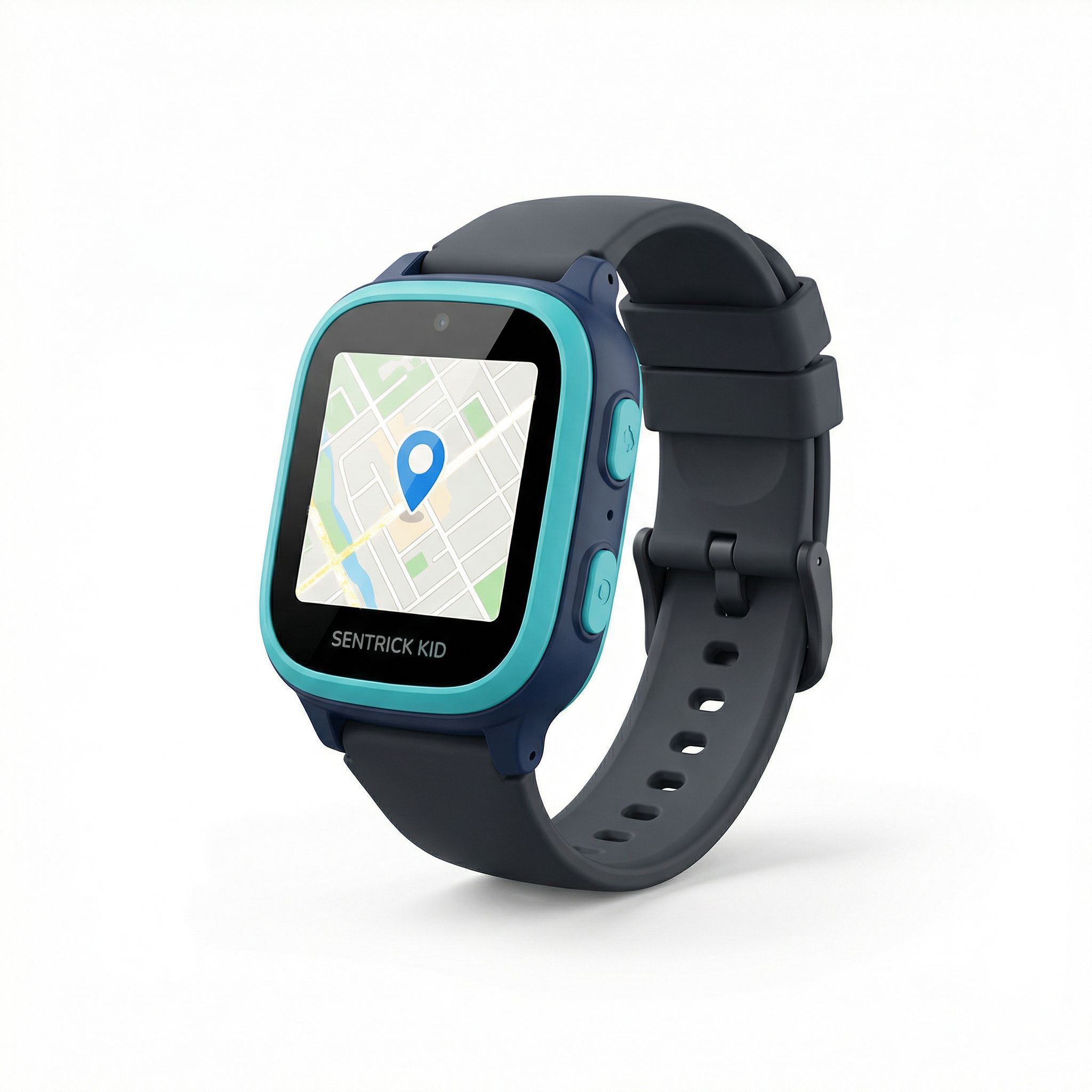
The SENTRICK KID™ smartwatch is designed with this balance in mind. The watch displays a small indicator light when location is being shared, ensuring the child is always aware. Parents can set "privacy zones" — such as a friend's home or a sports facility — where location tracking is paused, teaching children that privacy is respected even within a safety framework.
Data security is equally critical. All location data transmitted by SENTRICK™ devices is encrypted using AES-256 encryption in transit and at rest. Location history is stored for 90 days and then automatically deleted. No location data is ever sold to third parties or used for advertising purposes.
5. School Safety: How GPS Trackers Work with Educational Institutions
Many schools have policies restricting or prohibiting smartphones, but GPS tracking devices occupy a different category. A dedicated GPS safety device — particularly one without internet browsing, social media, or gaming capabilities — is increasingly accepted by schools as a safety tool rather than a distraction.
The SENTRICK KID™ watch is designed specifically for school environments: no games, no social media, no camera. It functions as a safety device first, with calling limited to a parent-approved contact list. This design philosophy has led to formal acceptance by school districts in the UAE, Saudi Arabia, the United States, and the United Kingdom.
For school administrators, SENTRICK™ offers an institutional dashboard that allows schools to monitor that all students have arrived safely, receive automatic alerts if a student leaves the campus during school hours, and coordinate with parents during emergencies. This transforms GPS tracking from a parental tool into a comprehensive school safety infrastructure.
6. SOS Alerts and Emergency Response Integration
The SOS button is the most critical safety feature on any child tracking device. When pressed, it should immediately trigger multiple simultaneous actions: send the child's precise GPS coordinates to all registered guardians, initiate an automatic voice call to the primary contact, and log the emergency event with a timestamp and location for documentation purposes.
SENTRICK KID™ implements a two-stage SOS protocol: a 3-second press triggers a "soft alert" (notification to parents), while a 5-second press triggers a "hard alert" (automatic call + notification + location sharing to all contacts simultaneously). This prevents accidental activations while ensuring genuine emergencies receive immediate response. The device also supports automatic fall detection — if a child falls and becomes unresponsive, the device automatically triggers an SOS alert without requiring the child to press anything.
Frequently Asked Questions
GPS tracking is most appropriate for children aged 4–14. For younger children (4–8), a wearable smartwatch provides both tracking and communication. For older children (9–14), a discreet tracker in a school bag may be more appropriate. Always discuss tracking openly with your child and explain why it's being used.
Modern multi-constellation GPS devices achieve accuracy of 2–5 meters in open areas. In urban environments with tall buildings, accuracy may decrease to 10–15 meters. Indoor accuracy is limited by GPS signal penetration, though Wi-Fi positioning can supplement GPS in indoor environments.
SENTRICK KID™ sends automatic low-battery alerts to parents when the battery reaches 20% and again at 10%. The watch also displays a battery warning to the child. When the battery dies, the last known location is retained in the app for reference.
Yes. SENTRICK KID™ supports two-way voice calling to a parent-approved contact list. Parents control which numbers the child can call and receive calls from, preventing unwanted contact while maintaining emergency communication capability.
All SENTRICK™ location data is encrypted with AES-256 encryption in transit and at rest. Data is stored on ISO 27001-certified servers and is never shared with third parties. Location history is automatically deleted after 90 days.